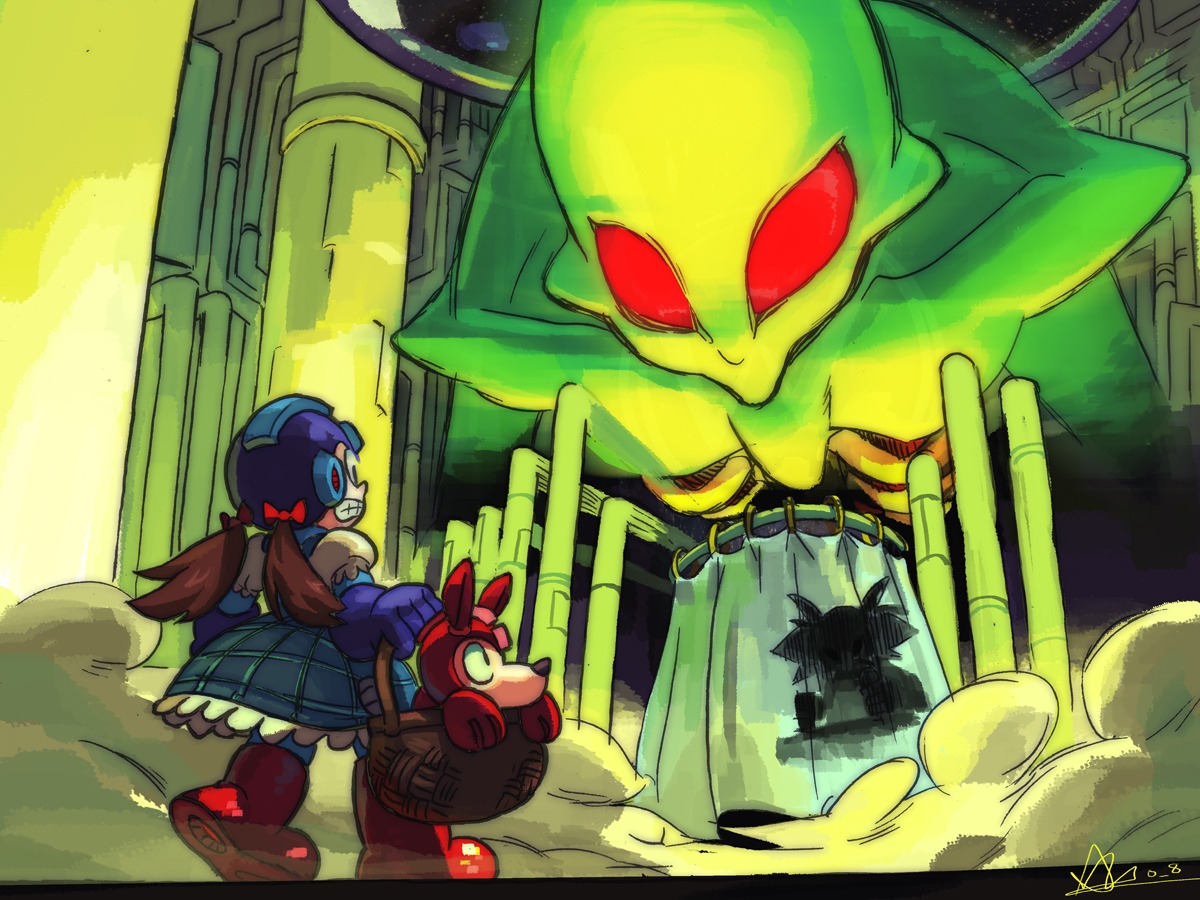
This post opens "Brace for Impact," another book sample for my upcoming monster volume (rough ETA, mid-2024) and one that follows up the previous book sample, "Psychosexual Martyrdom" (2024).
Note: "Brace for Impact" is actually a full module that divides into over thirteen pieces (clocking in at ~85,000 words, ~209 pages, ~139 images, and sixteen new exhibits). "Hugging the Alien" is the first chapter; "Time," the second; "Teaching" (the opening), the third; "Medicine," the fourth; "Facing Death," the sixth. The others are actually too erotic to feature uncensored on Blogger, so I will be posting them on my (18+) website, instead. Click here to see the promo post for the entire sample module and links to all thirteen pieces.
Abstract: "Hugging the Alien" introduces a concept of reunion with nature as alien and fetishized, requiring us to "hug Medusa" (the monstrous-feminine) as the classic punching bag of Cartesian forces (the abusive husband battering Nature as his bride-under-duress): something never anywhere near so awful to merit its own destruction by state defenders. This post will introduce the module's basic idea; the subsequent posts will be gradually released over the next week or so (see above). After that, I plan to release one more sample essay from Volume Two before its release later in 2024: "Derelicts and Giger's Xenomorph; i.e., the Puzzle of 'Antiquity.'"

About my book: My name is Persephone van der Waard and I am currently writing and illustrating a non-profit book series on sex positivity and the Gothic. Made in collaboration with other sex workers, the project is a four-volume set called Sex Positivity versus Sex Coercion, or Gothic Communism: Liberating Sex Workers under Capitalism through Iconoclastic Art. As of 2/14/2024, my thesis volume and manifesto volume are available online (the other volumes shall release over the remainder of 2024). To access my live volumes, simply go to my website's 1-page promo and pick up your own copies for free. While you're there, you can also learn about the yet-unreleased volumes, project history and logo design/promo posters!
Brace for Impact: Some Prep When Hugging the Alien
"The masses have never thirsted after
truth. They turn aside from evidence that is not to their taste, preferring to
deify error, if error seduce them. Whoever can supply them with illusions is
easily their master; whoever attempts to destroy their illusions is always
their victim" (source).
—Gustav
Le Bon's The Crowd: A Study of the Popular Mind (1895)
Just as the Humanities are endless, complicated and
focused on imagination, the liminal hauntology of war is constant. We must
interrogate this crisis carefully and with poetic license, which requires me
familiarizing you—through four stages of prep—with monsters as devices that can
be useful to developing Communism; i.e., beyond just saying "monsters are
poetic lenses" and spouting theory (academics are often terrible
teachers). Before we do, I'll want to introduce you to a poetic device that encompasses
all of them: "hugging the alien"; i.e., nature as fetishized and
alien to us, therefore something we must learn through liminal expression to
hug and humanize, not to kill and rape (re: "to take power away from in
order to cause harm") because it seems "unhuggable": some degree
of fearsome, violent and (often) gross per the ghost of the counterfeit, but
fascinatingly so.
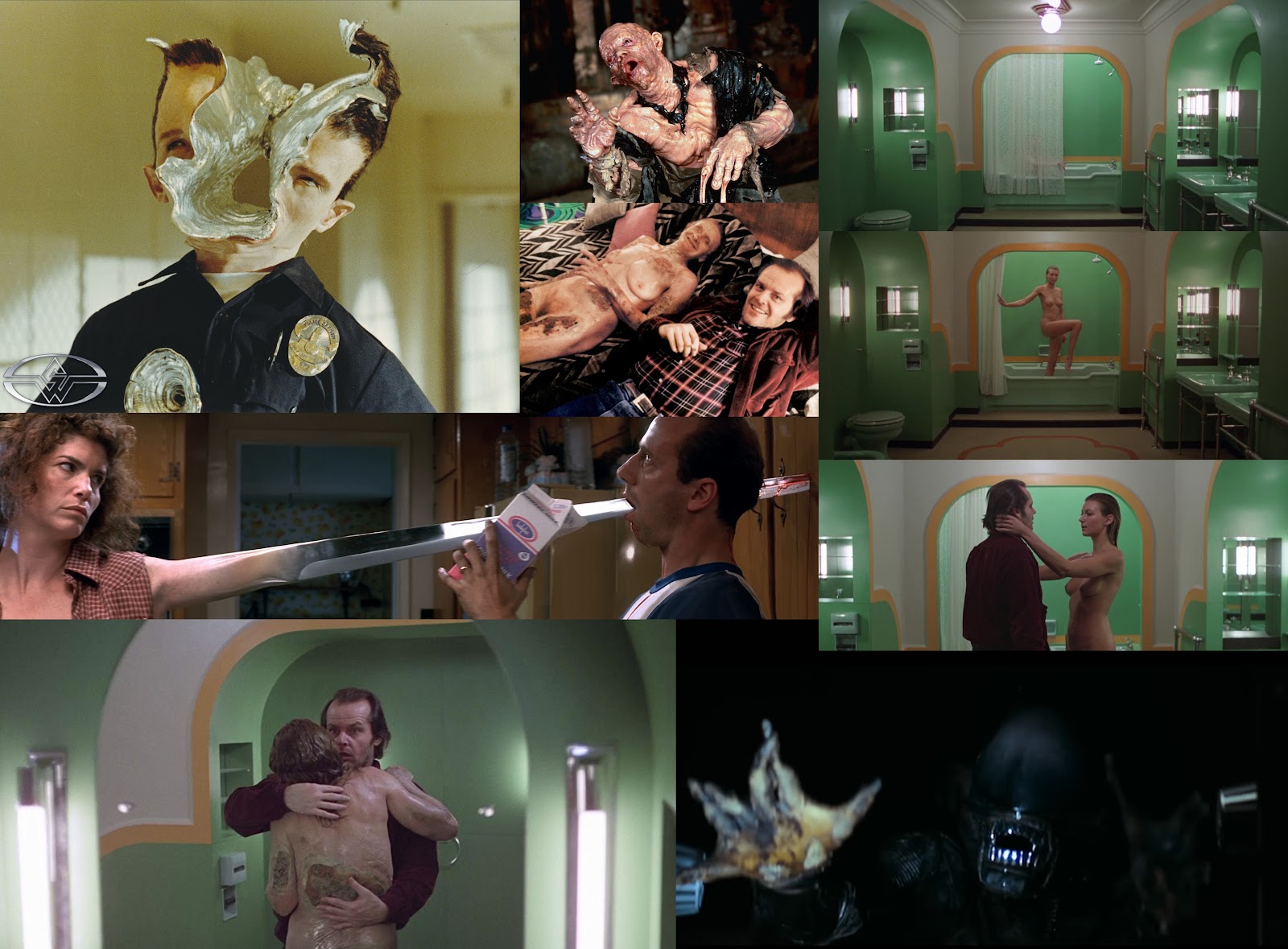
squeeze, but here's several fun ones to help you acclimate to the abjection
process: the presence of death, decay and disintegration linked to an unheimlich—often
a buried guilt, secret shame or some-such trauma-as-impostor overspilling
generationally to overwhelm the present moment as trapped inside the home as alien;
i.e., in between that which is desirable and not—a profoundly difficult thing
to face that, like Radcliffe's closed space, waits patiently in the central chamber
to be unveiled and embraced, but like Lewis' necromantic and genderqueer
predisposition, is prone to fall apart just as quickly in order to shock/disgust
the crosser of the Black Veil's forbidden threshold. Gothic push-pull
[oscillation] becomes something to canonize or camp to varying degrees, then—a memento
mori but also a death, murder and/or rape fantasy whose ill omen is communicated
in classic horror works that survive in present-day forms.)
There's clearly a poetically indulgent human element
to monsters as they exist in the real world, which means we'll have to
interrogate it as I teach you how to think critically about the human
condition as monstrous, meaning "alien" as something to hug and embrace
as human; i.e., like a Gothicist, a poet, a slut, based on my experience of and
expertise in the Humanities. This includes novels, movies and videogames, but
also art more broadly as performative through shared ideas gleaned in one
medium and passed along all of them over space and time:
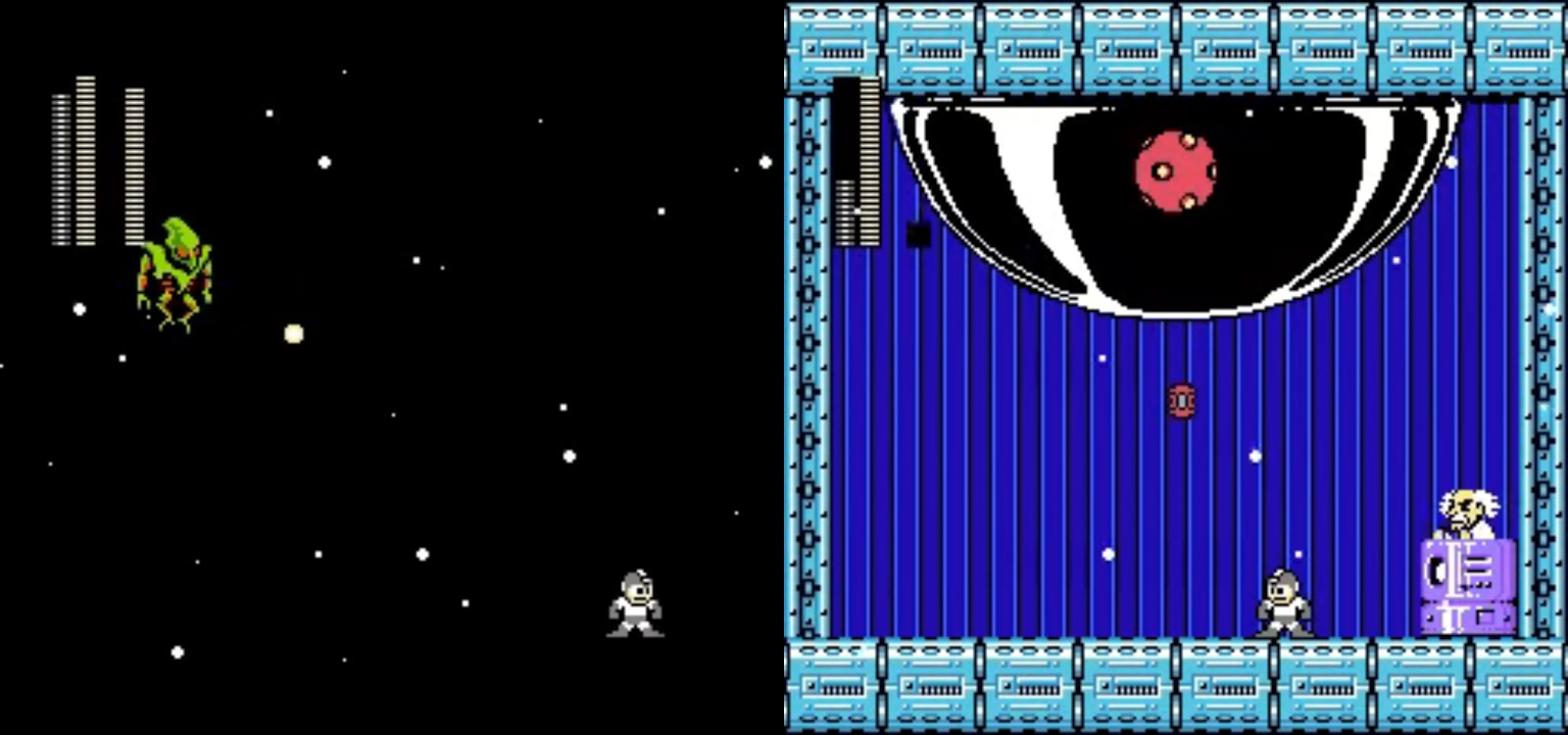
For example, the phrase "hugging the alien" actually comes from Mega
Man 2 [1988] speedrunners [Summoning Salt's "The History of Mega
Man 2 World Records," 2024; timestamp: 8:25] who—fighting Wily's
illusory machine as pitting a perceived alien against the player [an echoing of
Plato's cave of shadows]—don't want to hug the alien because it damages
them and slows down their ability to police rebels through race-like violence.
The neoliberal Cold-War refrain [videogames] have a "secret" military
function, one of ceaseless military optimism while chasing monsters through occupied
labyrinths that abuse the monomyth to funnel power towards the state; i.e., by
humanizing the cop as fundamentally inhumane.
franchised copaganda being problematic, we can still take the basic premise—the
man behind the curtain—and invert it, flowing power towards workers by hugging
the alien using said illusions ourselves. As such, we negotiate power and
trauma as things to perform and play with in ways that assist workers—by not
turning little boys into robot killers chasing the alien as a largely imaginary
affair with ghastly historical-material results: megadeath, thus profit [moving
money through nature-as-cheap] through fear and dogma making class traitors
scared of themselves, thus more inclined to harvest them anywhere and
everywhere once the state decays by design.
moral, here, is liberatory confusion; i.e., the senses are not
trustworthy but with the proper structure [and lack of scruples] can be
weaponized against workers by the state. This becomes something to reverse—all
part of a larger dialectic [of the alien] that needs to be confused to
liberate our raped minds from; i.e., all the predatory forms criminalizing workers,
thus sanctioning state violence against them. The violence becomes an echo,
something to repeat, but also shift away from itself through likenesses that
expose the men behind the curtain of the curtain as shamelessly
profiting through Gothic shams; i.e., through Cartesian thought as internalized
by the next generation.)
All
in all, I live the Humanities as a ludo-Gothic means of thinking inclusively about
and experiencing the Gothic first-hand (an ongoing relationship the Gothic
deliberately combines—an affect); i.e., BDSM or otherwise, people work through preference and
experimentation to issue public statements that are, to some degree, coded. Monsters
are code for the dialectic of the alien (us versus them) as taught to us
through canon, power being made to flow in one direction when faced with trauma
as a historical-material effect: the ghost of the counterfeit waiting patiently
for revenge (state shift). The horror of the Gothic, then, is when it truly comes
alive, ceasing to be a pure fiction but a nightmare that applies to us as
victims of the state cannibalizing us. History repeats itself; through me,
patterns start to emerge, which you can take and run with when "hugging
the alien" yourself. It becomes your Aegis to paralyze state illusions
with, reversing the process of abjection among the middle class as preying
on state enemies, sharing their fear.
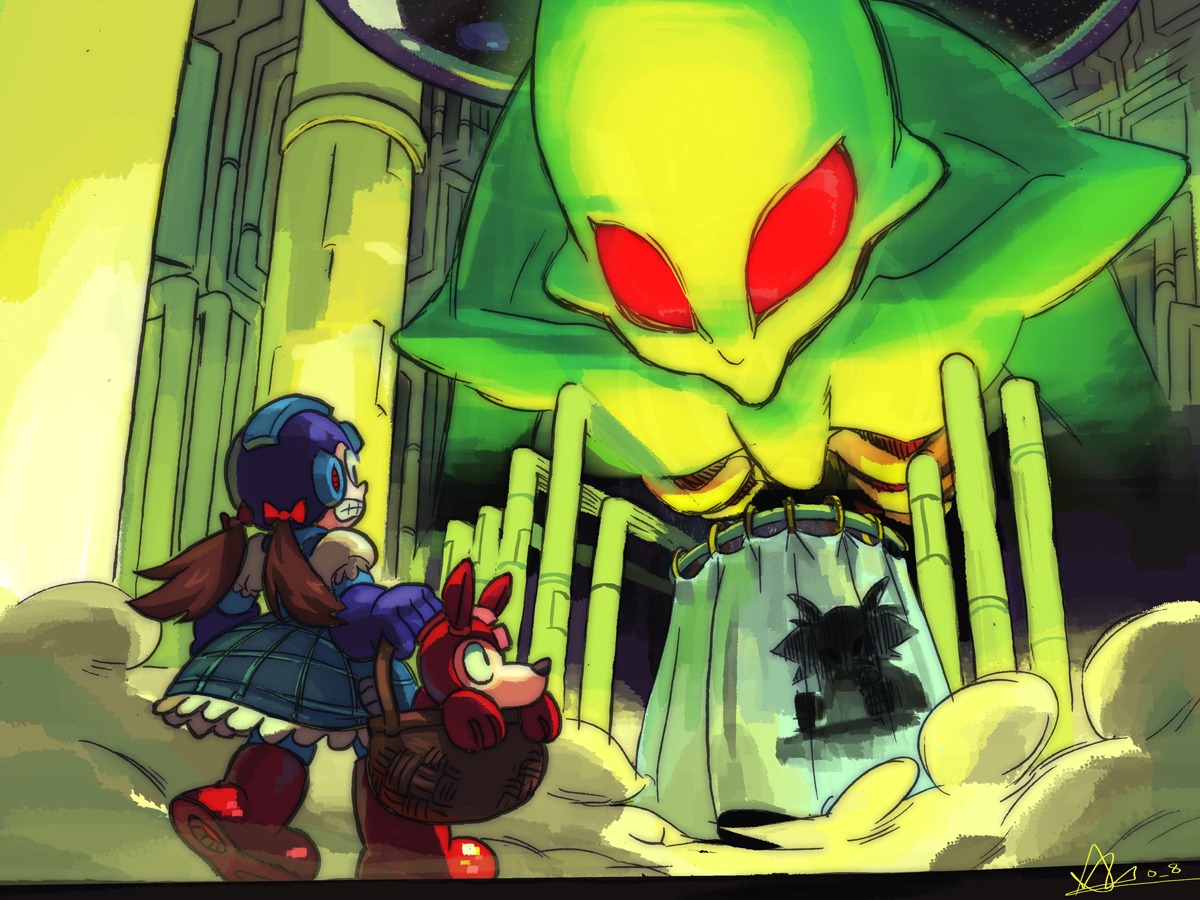
 (artist: Claudio Bergamin)
"Whoever can supply [the masses] with illusions
is easily their master; whoever attempts to destroy their illusions is always
their victim." Except, Le Bon's grim assessment is a tad premature,
insofar as it entirely discounts the potential for proletarian illusions
to humanize those ordinarily victimized when breaking state spells to begin
with. This requires internalizing a tendency to embody the alien as something
to investigate through itself as normally prescribed. The means of doing so
helps reclaim the illusion as an educational device teaching workers empathy
with Gothic fetishes and clichés; i.e., to play and perform at all registers (diegetic,
para and meta) using all media forms: wanting to a) fuck and hug the alien (the
proverbial "weirdest boner") as perceived among their fellow workers
and nature at large, and b) recognize the true predators weaponizing fight-or-fight
among them—the elite and their dutifully rapacious[1] servants. The end game is
a world without sin as a canonical device meant to engender systemic, dogmatic
harm; i.e., weird canon endlessly harvesting nature-as-fetish-and-alien at home
and abroad.
At a presentation level, Gothic Communism reduces to
one central goal: illustrating mutual consent as an educational device—i.e.,
one that makes rape[2]
of the alien impossible on a cultural level; but doing so requires humanizing the
alien through iconoclastic engagement with dogma as something to break (and
along with it, Capitalist Realism). Our
aim is to go "there and back again"; i.e., in and out of Hell as a
pedagogy and lifestyle to invoke the alien with during liminal expression,
albeit at cross purposes. Capitalism gentrifies rape and war through various
refrains, monopolies and trifectas; Gothic Communism pushes back against these
by contributing to a pedagogy of the oppressed any way it can.

In short, we want to hug the alien, therefore contribute to a pedagogy of
the oppressed by synthesizing praxis, invoking the dialectic of the alien to
confront and interrogate trauma (and power) as something to perform and play
with; i.e., ludo-Gothic BDSM as a potent means of embodying likenesses among
differences, its dark theatricalities ushering intersectional solidarity in by
humanizing monsters as de facto (extracurricular) teaching
devices: to be more creative and poetic as a means of attaining praxial
catharsis, collectively illustrating mutual consent thereby raising emotional/Gothic
intelligence and class/cultural awareness, mid-struggle. Catharsis amounts to
reversing the flow of power away from the state (and its powerful illusions)
through our daily interrogations.

Capitalism uses fear and dogma to claim ownership over
all things and alienate workers from their labor as something to sexualize; in
turn, state proponents will try to alienate us from the very things that can
set workers free: violence, terror and poetic expression—the Gothic,
essentially. And we must take it back using the same devices in opposition
(dialectical materialism). Things will seem weird, backwards, and confusing to
you; they will require strange sacrifices that fly in the face of reason and
protocol, leaving you breathless. Egon says, "Don't cross the
streams!" Well, his work was doo-doo. That's exactly what we're
gonna do!
This concludes "Hugging the Alien"; onto "Time"! After that, check out my website for the uncensored samples!
Footnotes
[1] The arbiters of state force, cis-het and token enforcers, become alienated from nature as something to love and nurture through mutual consent as taught by workers of nature. In response, weird canonical nerds can only reject such tutelage, thus only rape Medusa; i.e., harvesting her materials and labor (as raw profit value) for the state. We must first incapacitate them with Athena's Aegis (our bodies, labor and knowledge) and gradually foster empathy among them; i.e., using Gothic poetics to shrink the state, taking away its ability to marshal/aggregate their soldiers against us: labor action and propaganda (the Base and Superstructure). Per my arguments, this occurs during liminal
expression, insofar as any media type wrestles between the canonical
function/monopolizing of power as something to flow towards the state; the inverse
is also true, both existing through agitated confusion as class/culture war
fought using Gothic poetics inside the same shadow zone—as something to
canonize or camp.
For example, speedrunners can be used for workers or the state, but must always contend with capital (from Volume One):
Power is a
performance that upholds through the perception of impossible things like total
control, endless enemies, ultimate strength or absolute victory through kayfabe
reversals. The same goes for containment, whose paradox of total imprisonment
our thesis discussed in relation to videogames as breakable; i.e., how
speedrunning and spoilsport gaming attitudes normally contain tremendous
invention that canonically restrict the development and execution of emergent
puzzle-solving to single texts in gaming culture, versus applying that
mentality to reconfigure larger extratextual structures; e.g., Coincident's
"Doom Strategy Guide -
Okuplok's Mancubus Cliff" (2023) treating player invention more as a
hobby on par with a Rubik's cube—or hell, a
human beating Tetris (1985) for the first time in its 38-year existence
(aGameScout's "After 34 Years, Someone Finally Beat Tetris,"
2024)—versus escaping Capitalist Realism by playing videogames (and other such
experiments) in ways that resist the profit motive within the neoliberal era
(with organized speedrunning arguably having started in 1990, just before the
fall of the Soviet Union). The puzzle is ostensibly impressive, but the
much-touted "progress" of solving it becomes an empty gesture insofar
as liberating worker minds is concerned. Doing so has no effect on the external
world unless the attitude for solving complicated puzzles through
emergent gameplay is deliberately taken outside of the text. Otherwise, the
hauntology (and its canceled future) are entirely self-contained (source).
So while I respect the ability of speedrunners to collectively
solve complex puzzles (enough to use their idea for my own purposes), we must take
Gothic Communism outside of any text as close-read—to develop emergent gameplay
as a praxial effect; i.e., the universalizing of empathy towards monstrous parties
alienated and fetishized by the state through franchised neoliberal copaganda
(videogames); e.g., Mega Man 2, but also Super Metroid (1994): Samus steals
life force vampirically from native fauna as something to "race through";
she steals gear and equipment from preexisting habitats occupied by pirates, attacking
and killing wild-animal monsters (Mama Shrimp and Mother Brain) before being saved
by an adopted monster baby she stole from the Metroid Queen. In the end, Samus
routinely disrobes and surrenders her pilfered gear to the Galactic Federation,
going endlessly back in to play the guerilla infiltrator—killing all enemies and looting all items, effectively clearing all rooms before destroying the crime scene. This cycle is called "Capitalism," or moving money through nature.
[2] Rape is
something of a paradox: a conscious attack made by those capable of performing
it, but also a conditioned one; i.e., animals can't rape, because it requires both a
power imbalance and understanding of one's actions; e.g., a baby or a
chimpanzee can't rape a human woman, but a precocious 12-year-old could rape a
disempowered old woman, or a child could rape an infant, etc. It might seem
morbid, but understanding how rape works is vital to preventing it by putting
it in quotes. For example, a common dialog is rape as a secret shame lived by
many people through various theatrical clichés, which have BDSM potential we'll
explore more thoroughly later in the volume: "princess" as
"damsel"; i.e., pillow princess, warrior princess, detective/demon
princess—in kayfabe, but also ludo-Gothic BDSM at large; e.g., fairytale
language (from Volume One):
Fairytales classically consider a
child's confrontation with an adult world, oscillating between innocent,
asexual depictions of idyllic bliss faced with troubling positions of
monarchist authority and force: the parental figure, often portrayed as saintly
or wicked while compelling the child's coming-of-age to fulfill a sexually
reproductive role within a crumbling homestead (source).
Again, the idea is to go there and back again; re: in and out of Hell as a
pedagogy and lifestyle to operatically invoke the alien with during liminal
expression. To that, the Metroidvania (and videogames at large) canonically
function as war simulators; but this role isn't universal, nor the power inside
monopolized exclusively for the state. Workers and counterterror can reclaim
such spaces (and likenesses in other media forms) to relay information useful
to workers synthesizing praxis in opposition to state hegemony.